
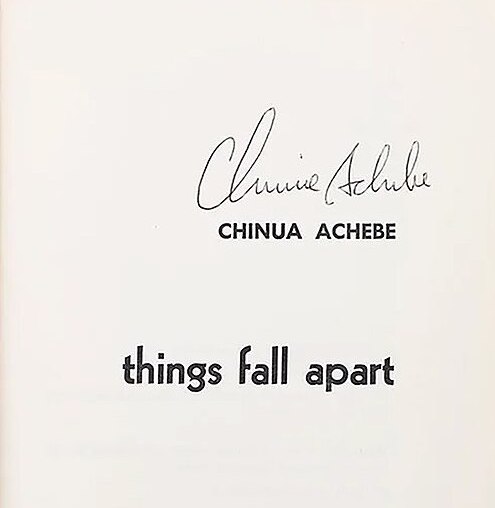
While my former friends were having profound literary conversations at Conference Two in Yaoundé today, I went there and stole the original handwritten manuscript of Things Fall Apart. But see eh, that didn’t just happen the way I said it o, because the story is far more complex than you think; and it is only when I tell you the whole story, very honestly, that you will understand that I am not really a manuscript thief. Achebe is the one who demeaned and punished me. Yes, when for the longest time, I considered him my henchman, way back when he used to go by the name Albert.
Earlier this morning, a young man pushed Achebe in a wheelchair from the entryway of the auditorium to his position in front of the conference table on the stage. The audience applauded. A man of the people. It was the first time I had seen him since the car accident that had paralysed him. I shifted my gaze to the camera crew and technical team, giving them instructions instead of clapping. I had been invited by these literary elitists to report as a journalist on Conference Two, supposedly a continuation of the literary work we started at the first Conference. I glanced again in Achebe’s direction, and our eyes met. His mouth creased into a warm smile. I walked towards him. My former friend looked much older.
“I can see that you have made something for yourself as a big journalist, Z,” he said, extending his right hand, which I took, also smiling. What did he mean by that? Was he still punishing me? A question of power. Yet he spoke no more, and the resentment I felt from all those years ago began to flood back.
One of my junior colleagues stared at us in shock. I could read what was on her mind.
“How do you know Chinua Achebe?”
I felt like slapping her, that nyamfuka, but I didn’t, for she will never know. Yes, they will never know, my junior colleagues, that Albert and I used to be henchmen at University College Ibadan.
I was the only student from British Southern Cameroons in the new university’s first intake of British Nigerian students. I was wary of interacting with them, because some of them mocked me for being doubly colonised. Except for Albert, one of the few British Nigerian students who had received a bursary to study medicine. I majored in journalism, and we shared a bunk in the same dorm.
One week after we met, I saw Albert in the library, reading Joyce Cary’s Mister Johnson.
“Are you enjoying that novel?” I asked.
“There is a cheerful British Nigerian man in it, but…” Albert scratched his head. “I don’t know.”
He began to tell me how his passion for stories sprung from the folk stories his mother narrated around the kitchen fire. I told him how my passion for stories stemmed from the football commentaries I heard on Radio Buea. Instead of mocking me like the others did, Albert asked me empathetic questions about what it felt like to exist in a complicated political situation like mine.
I realised how entrenched Albert was in storytelling the day he missed lunch. Worried that he might have fallen ill, I went to our dorm to look for him. Albert was leaning against our bunk bed. His back to me. His eyes on the ceiling. I called his name. He turned around.
“You skipped lunch.”
“I’m fine, Z. It is just….” He paused. “Tsuip. That malicious Mister Johnson has really annoyed me. It portrays all its British Nigerian characters as either savages or buffoons. The cheerful British Nigerian man I told you about works for an abusive British owner.”
I held my laugh.
“I dislike the cheerful man. Chineke! The whole book just reeks of cultural ignorance and racism,” he pointed out. The laugh emerged from my mouth, loud and choky, and Albert shot me an angry look.
“What’s so funny?”
“You are so angry about a novel that you missed lunch?”
“It is not funny,” he said, looking away. “Books like that shouldn’t be on our curriculum, Z.”
I applied the parking brake to my laughter.
“What are you going to do about that?”
Albert looked at me. “I’ve been thinking about quitting medicine.”
“Uh! Just because of Mister Johnson, Albert?”
“I want to write a novel.”
I carried both hands on my head. “Chai! Albert! It is like you want things to fall apart.”
“Why?”
“If I tell my old man something like that, it’s his mulongor that will answer on my buttocks.”
He giggled. “I would continue to do medicine if I could find the time to write, but I can’t.”
“You know that you will lose your bursary, right? Have you thought about what your parents will say?”
Albert scratched his head. “It is going to be difficult for them, but I feel like it is the right thing for me to do.”
“I don’t understand. Independent Nigeria will need many doctors, and there aren’t many of you in this school. After you write a novel, then what?”
Albert took a deep breath. “I’m going to become a writer and tell our stories through our own lens. There is literature in print in Yoruba and Hausa, but there’s nothing from Igboland, where I’m from. I want to try and change that.”
We stared at each other. I shook my head. Here was a young man destined for a fine career in medicine. Yet he was willing to let that go just because he wanted to write books. What madness had possessed him? I doubted whether publishers in Europe had even carved out space for what he wanted to become. Albert touched my right shoulder.
“Don’t worry. My father will not flog me with his koboko.”
Albert changed his major. He began to read voraciously, more than all of us, to the point that our classmate, Christopher Okigbo, nicknamed him Dictionary. I accompanied Albert to the library sometimes, but I spent more time playing football, which he had no skill in.
Those were the good old days, I tell you, not like this Conference Two today. Achebe, the star du jour, was the first to address the attendees this morning. He only spoke with Soyinka, Mongo Beti, Bate Besong, Bernard Fonlon and a light-skinned Cameroonian lecturer after that, during our two breaks before midday. Never me. It was surely punishment because Achebe was acting like I was not even a writer anymore. But guess what? We had all been writing since our UC Ibadan days.
We had shared a genuine camaraderie and joie de vivre at that first Conference, where we met promising writers from other African colonies. We used to leave the conference hall to eat and drink at the Kwassa Kwassa bar during the breaks, in what we nicknamed the Counter-conferences. Mongo Beti asked Okot p’Bitek to watch a classic cowboy film on VHS with him, but when the film started, Okot p’Bitek fell asleep and Mongo Beti watched it alone. This while Albert elucidated on the blueprint of his African-styled house to Soyinka, Okigbo, Obi Wali and I.
Soyinka listened and frowned at Albert’s blueprint. “The design of your house is flawed; it would not permit ventilation.”
Okigbo and I echoed Soyinka’s claim. Albert glared at his blueprint.
“None of you are architects here,” he said, and walked past Okot p’Bitek to order more beer. We burst into laughter so deafening it awakened Okot. Sleep-drunk, he sprang up and ran towards the open bar door, and we chuckled even more. Yet it was all business when the Conference resumed the next morning.
Obi Wali presented his essay, “The dead end of African literature,” which proposed each writer’s own African language as the medium in which to write. Okot p’Bitek spoke next, encouraging everyone to publish in African languages, as he had done in Acholi. Soyinka suggested Swahili as the transcontinental African language. Then Sheikh Shaaban bin Robert took the stage. Yes, Swahili was gaining continental prominence, he said. Yes, radio programs were increasingly broadcast in Swahili too. However, he still noticed an apathy among the people toward literature written and published in Swahili. He told of the difficulty he faced in trying to publish his Swahili work.
Instead of drawing applause, Shaaban’s presentation transformed our hall into a noisy, debating horde, also precipitated by the fact that it took several minutes before the next speaker, Albert, walked to the stage. He held the microphone and peered at everyone, but the cackle in the hall did not die down.
“I may write in English, but I intend to do unheard of things with it,” Albert shouted and waited for the noise to fizzle out. He produced a handwritten copy of his first novel manuscript and began to read from it. It was the story of a yam farmer, Okonkwo, who had risen to prominence in his village, unlike his debtor father, Unoka. Albert read sentences such as: You, Unoka are known in all the clan for the weakness of your matchet and hoe. Another was, They called him the little bird nza who so far forgot himself after a heavy meal that he challenged his chi. And then, For three or four moons it demanded hard work and constant attention from cock-crow till the chickens went back to roost.
Albert, a gripping reader, enacted his story’s macho protagonist in his quiet voice. Nobody made a sound when he paused. “But my style, which relies heavily on Igbo oral tradition, also combines straightforward narration with representations of folk stories, proverbs and Igbo words,” he said.
That is when Mongo Beti, who had published two critically acclaimed novels in France, stood up. “I love your ancestral voice. It is, em, un style ingénieux. But how will the English judge this your unheard-of-English? I’m a non-native speaker of French. I think and feel in Ewondo first, then write that in my own transliteration of French, but it is still proper French. Perhaps you can write your novel in proper English too?”
“This manuscript can only work if I write it this way,” Albert disagreed.
“But you are planning to publish it in England, no?” Mongo Beti asked him.
“I think that idea of what proper English is has become an obsession in the British colonies. People keep criticising the English of others, even though nobody really speaks perfect English, whatever that is. It is one of those things that just screams ‘British colony!’” he said, emphasising the phrase “British colony”.
Everyone laughed. Okot p’Bitek raised his right hand towards the audience to hush everyone.
“I don’t think your unheard-of-English will be widely read. This in-betweenness is a kind of intellectual smuggling. Just write your book in Igbo. If you want to reach a wider audience, then translate the story from Igbo to proper English, just like I translated my poetry in Acholi to proper English.”
Albert shook his head, as a few writers yelled, “Yes, yes.”
The room got fidgety again. Linus T Asong stood up.
“But Okot, my language, Nweh, is only an oral one,” he said.
Okot p’Bitek glanced at Asong. “Oh, I did not know that.”
“It is a fact,” Asong said.
Okot p’Bitek bit his lip. “Then we have a problem, because there may be many other oral African languages too. Perhaps the linguists from your ethnic group can work on developing a written form?”
“There is none,” Asong informed him.
“I think we should just write in whatever language or even languages we want to write,” Nuruddin Farah said.
I did not know what to say, and had not really planned to speak sef, but Nuruddin’s suggestion appealed to me because of the colonial legacy of English and French in British Southern Cameroons and French Cameroon, so I yelled alone, “Yes!”
At that point, Dambudzo Marechera walked towards the centre of the hall.
“I’ve not prepared any fancy speech because I’m not a speaker today. I don’t even write like any of you, but I have a question.”
He swept the hall with his blunt gaze, from left to right, then right to left, and boomed: “Where are the itinerant storytellers, the griots, the bards and the praise singers in this academic conference? Uh? Where are the descendants of the composers of the epic of Sunjata Keita?”
“Dambudzo, please go and sit down. It is Aidoo’s turn to talk, not you,” Mongo Beti scowled at him.
Ama Ata Aidoo rose, coughed and cleared her throat. Dambudzo stormed off, shouting at the top of his voice: “Haa, there are also killings in the east, you hear me? Killings in the east, while you are all here talking literary politics. Rubbish.”
Some attendees booed him. Others turned towards Aidoo.
“That’s an interesting way to introduce me, you know,” she said. Those attending booed Dambudzo even more.
“I have a question for you,” Aidoo looked at the audience. “Which is not motivated by Dambudzo’s angry rant. Where are the female writers from Africa in this conference? Where is my friend Buchi?”
“Perhaps having another baby,” someone said.
Aidoo jeered at him. I sighed.
We had witnessed Albert’s wonderful stylistic innovation, and yet we were still at a dead end on how to write African literature.
*
Perhaps you are wondering how Albert forged his unique style demonstrated at the Conference. It all started at UC, where he wrote his first essay, “Polar Undergraduate,” which was published in The University Herald. Albert showed Okigbo and I the first draft; it was an innovative piece which used humour to celebrate our intellectual rigour. Well, except for my intellectual rigour, which irritated me.
The line about Okigbo from the essay that stood out for me went, “Okigbo is no oyibo.” My evocation of Okigbo, chuckling as he read the section which referenced John Pepper Clark, is still intact. “Polar Undergraduate” claimed that John Pepper Clark did not like pepper, and he always complained that there was too much pepper in our pepper soup.
“Isn’t that the point of pepper soup?” Okigbo wondered, when he finished reading.
Students flocked to the library to read a copy of The University Herald. They laughed, argued and engaged in commentary on how Albert had amused everyone while making a serious point. Even our British teachers commented that they had never before witnessed university students engaging with a work by a classmate, for his classmates and about his classmates, like that.
“Polar Undergraduate” also inspired me to start writing a short story about my character’s existence in a complicated political liminal space. When I told Albert that I had completed my first draft a week later, he smiled and told me to submit it to The University Herald. The story was accepted for publication, and I basked in my first moment of literary glory. Albert, motivated by the rave reviews of “Polar Undergraduate”, continued to write and publish in TheUniversity Herald; Soyinka, Okigbo and Clark too.
Things started to fall apart between Albert and I the day The University Herald appointed him as student editor. I helped Albert to read submissions and select stories for publication. I had published two short stories in The University Herald, and had just completed a third one before Albert’s appointment. I submitted it to the editor-in-chief, who usually passed the stories on to Albert, his first reader.
Albert rejected my story on the basis that the characters weren’t well drawn. He had done some in-depth edits, and suggested that I work on it some more, then resubmit it. The audacity. Were my first two stories not accepted and published by the editor-in-chief? Why was Albert’s first move upon accepting the role as student editor to reject me? Perhaps he wanted to shine alone. I abandoned the draft of that story.
A few weeks later, Albert asked me if I had made the revisions, but I told him that I was busy. I dreaded his next enquiry about it, but it never came. I began to doubt if I was as talented as my four writer classmates. I also stopped reading submissions with him because I had to focus on my football practice. And that is why I never submitted to The University Herald again. If Albert, Soyinka, Okigbo and Clark were the stars of the magazine, I was a bigger star on the football field.
Soyinka left UC for Leeds University before we even graduated. I passed with a second-class lower division Honours degree, so I couldn’t study for a Master’s degree at a prestigious university in Britain on a scholarship. I signed with Lagos FC and moved to Lagos to play for the team. Clark remained in Ibadan. Albert accepted a teaching position at a school in Oba, and Okigbo eventually joined the army in the Eastern Region.
While playing in Lagos, I was also fortunate to gain employment with the Nigerian Broadcasting Service. It was a good job, editing scripts written in English for the sports desk. It was not too taxing, which enabled me to play in the Lagos stadium, where I met my future wife, Felice. She was also from British Southern Cameroons, and was studying at the University of Lagos.
I kept in touch with my UC classmates through handwritten letters, but for a long time, I did not hear from Albert. I finally received a letter from him nine months later. He apologised for staying out of touch. It had taken him a long time to settle into the job. The school in Oba was a far cry from UC. Did I know that the school was constructed on a forested piece of land believed to be haunted by evil spirits? The residents called the piece of land “bad bush”.
He had just discovered and was reading Cyprian Ekwensi’s debut novel, People of The City. It was a decent attempt, but he felt that the novel was didactic. He was still writing, grooming his own unique style, although he was beginning to have some doubt about succeeding as a writer. Was I still writing?
I closed the letter immediately, imagining Albert, destined to become a medical doctor, languishing in a dilapidated school in Oba. I enjoyed writing, but not as much as he did. I still wished to write a novel manuscript, an expansion of my first published story at UC, from the perspective of my doubly colonised character.
It seemed writing had now become an obsession to Albert, even as he said that he was beginning to doubt himself. Perhaps it was the stress from his uninspiring job? His letter was timely too, as there was a vacancy at NBS’s Talks department. I replied to Albert, telling him about the opening. He replied a few weeks later: he was willing to try out for the position.
Albert travelled to Lagos, and I took him to the NBS office for his interview. He passed, moved in with Felice and I, and started working for my boss, a British woman named Mrs Beattie. It was a happy and strange reunion; Albert wrote way more than I thought he would. He was happy to learn that I was writing too.
A few weeks into his stay, we realised that Albert was not willing to spend quality time with us. The least free time he had, even at night, he would choose to write. During the day, if there was not much to do at work, Albert would write in the office.
On one such laidback day, I was talking about a football match we had won, when he interrupted me. “Z, you remember the bad bush in Oba? I have written about it, but renamed it ‘evil forest’, in a novel manuscript about the clash between Christianity and African traditional religions.”
I gawked at him. He stared back. As if surprised that I had not engaged with his snooty comment. You see, Albert and I never fought each other with our mouths, nor our clenched fists. We fought with our pointed looks and our minds. But on that day, I think it dawned on both of us that we had drifted apart.
There was this other day too, when we were all sitting quietly in the office during the Queen’s visit to British Nigeria. Absent-minded, Albert quipped: “The Queen’s visit has made me think deeply about the influence of colonialism on British Nigeria. I will include that in my manuscript.”
We all glanced at Albert in shock, and he froze, eyeing Mrs Beattie like a cornered thief. Our boss, however, said: “Tell me more.”
And that is how Albert became her favourite. During her daily breaks, Mrs Beattie would press play, and Radio Albert would start rolling the tape of his manuscript like a Beatles song.
I grumbled in my throat. “What is so special about Albert’s writing that Fagunwa, Ekwensi and Tutuola have not shown her sef?”
Albert even gave Mrs Beattie the manuscript to read when he finished it o, but he never gave it to me – only those annoying writing updates.
I still recall the glint in Mrs Beattie’s eyes when she finished the book. “It is so innovative! One of the best works of literature I have read since the war.”
I wanted to faint. Worst of all, Albert was promoted not long after that, but I wasn’t. I don’t know. Did she promote him as head programmer for the discussion series because she was impressed with his manuscript? Okay, maybe I am overreaching, a faux pas, but the fact that Albert moved to his own place just before his promotion was strange. Did she tell him beforehand?
Albert also moved before I sustained a serious knee injury which kept me off the football field for months. He did not visit me often in the hospital. He only came with gifts a few days before I was discharged. I feigned a smile, but I was boiling inside because he hadn’t been there to support me when I was worried that I might never walk on two legs again.
One day, Albert told me that he had finally crafted the manuscript to his liking, as we sat drinking at a bar. We made a toast. He also said he wanted to post it to a typing company in London. At the time, there were neither typewriters, nor typing companies, in Lagos. Sometimes, Mrs Beattie posted important handwritten documents to London, and they would be typed and posted back for a pricey fee.
I congratulated Albert, although deep down, I wished that he had not finished writing his manuscript. He looked so happy that day, but I kept wondering if he knew how painful my injury and his hospital abandonment had been. Even though my injury healed, my football career was finished.
I had always wondered why Albert gave me all those writing updates without showing me his manuscript. At the bar, I concluded that he just considered me as his ideas board, someone who always listened to him. Although I contributed little in response to his speeches, I learnt a lot from Albert.
Today, I’m thinking about how all that transpired between us all those decades ago snowballed into what I did at Conference Two in Yaoundé. I went around the auditorium after midday, supervising and listening to snippets of the writers’ exchanges. Achebe was having a long conversation with the light-skinned Cameroonian lecturer about the original handwritten manuscript of Things Fall Apart. I eavesdropped behind a camera. It seemed they had been communicating for a while. The Cameroonian lecturer said Achebe’s mind was a beautiful place, and he was curious to know about his artistic process for research purposes. He was teaching a course on archives in three African universities, and the original, handwritten manuscript of Things Fall Apart was the crème de la crème of our intellectual artefacts.
Achebe beamed. He even agreed to lend the researcher the original handwritten manuscript. I shook my head. He wanted to give this young stranger his manuscript, just like that. That manuscript, the one he had never shown me, not even while he was writing it. That manuscript, which didn’t go missing in London before it was published, thanks to me. Oh, have I not told you that story yet?
Well, all those decades ago I resumed work at the NBS after my injury healed. Albert asked me to accompany him to the post office, so he could post his sole handwritten manuscript. As we walked there, Albert said he had named the manuscript Things Fall Apart. He even explained how one of W B Yeats’ poems inspired it. Chineke! That is a blatant lie: Albert took that title from me. Yes, the day he told me that he was going to change his major, and I exclaimed: “Chai! Albert, it is like you want things to fall apart.”
A strange silence crept between us, and I almost asked him: “What if your sole handwritten copy isn’t posted back?”
Instead: “Why didn’t you rewrite another copy as your back-up?”
Albert shrugged as he sent the manuscript through the space beneath the broken glass.
“No time, Z. It is even a miracle I completed it, considering my hectic schedule.” I almost looked away. “Mrs Beattie says the typing service is meticulous.” I looked away then.
We returned to the office and started counting. Four weeks. Five weeks. Six weeks. After seven weeks, Albert walked to Mrs Beattie’s seat and asked her when the typed scripts would be posted.
“About three weeks,” she said. But after seven and a half weeks, a moody Albert was back at Mrs Beattie’s workspace. He didn’t need to say anything. She didn’t need to ask him anything. Just one glance at his face and she could tell.
“You have not received your manuscript after paying twenty-two pounds?”
Only a nod, for Albert was so shattered he could not even answer.
“That is some shit on a biscuit!”
We all glanced at Mrs Beattie, because that was the first time that anyone in the office had ever heard her swear.
“All my typed work has been posted back to me in three weeks,” she added, but I wondered if Albert even heard that.
He started staring at the ceiling. He missed lunch. Seven and a half weeks became eight weeks, and Radio Albert stopped working because the tape was stuck. So each day, Mrs Beattie would open him, carefully stick her pen into him to pluck the tape out of him, and try to reconfigure him, so that the tape inside him would play again.
Albert remained so inconsolable that he did not speak with anybody but himself. He would do his work in his workspace next to mine, mumbling that he had put so much into his manuscript, four years of work, and now it was gone.
So, when eight weeks became nine weeks, Albert’s mumbling shrunk into a mumbo-jumbo that even I didn’t understand. He only caught himself when I stared at him for too long. I recalled how he had shrugged off my back-up copy question and I smiled “I told you so” inside. And when nine weeks became ten, Albert’s claptrap rose slightly to a beaten baritone.
“Z, you were right.”
My heart leapt. Oversabi. He didn’t even need to elaborate. We both knew.
I touched his shoulder. “Let’s be hopeful, my henchman.”
He shook his head. Mrs Beattie walked past us. She stopped and turned back to our workspaces. We both glanced at her.
“I’ll be travelling to England tomorrow for my annual leave. This is goodbye.”
“Travel safely, ma’am,” I said, but as she reached the door, I looked in her direction again.
“Ma’am, perhaps you could…” She turned, intense eyes on me.
“…em, kindly check on Albert’s manuscript at the typing company?” I suggested, pointing at Albert, who rose, the dark caves in his eyes lighting up.
“Oh, that’s a brilliant idea, I will. What’s the address?”
Albert shuffled some papers, scribbled the address, and gave it to her. Mrs Beattie left, and Albert smiled for the first time in weeks.
“Thank you, Z. I did not even think about asking her.”
Two weeks later, Albert received a letter from Mrs Beattie. We read it together. She said she had gone to the typing company and discovered that his manuscript was lying ignored in a corner. She had angrily demanded to know why. They promised it would be mailed to him soon. Albert’s typed manuscript arrived at our office three weeks later.
I can still see the smile on Albert’s younger face, as bright as the lights of the ever-increasing high-rises of ever-expanding Lagos, when he opened that brown carton and peered at his handwritten manuscript, together with the hurriedly typed copy of Things Fall Apart.
“To be honest, if these had not returned, I would have been so discouraged that I would have stopped writing,” he said, as Radio Albert switched back on. Mrs Beattie celebrated the rescued manuscript with me. Deep down though, I wished that the manuscript had gone missing, so that Albert would have learned a lesson.
He posted the manuscript to an agent in London, after improving it some more. Several publishing houses rejected the manuscript. One even claimed that fiction written by an African writer had no market potential. Finally, Heinemann decided to take a chance on Albert’s manuscript.
*
Over the years, I’ve always wondered what would have happened to Albert’s manuscript if (a): some sneaky white British writer had discovered it abandoned in that corner of the typing company and published it in their name, claiming that they had invented an authentic African voice, ready-made with Igbo proverbs and folktales. If (b) some janitor had dumped it in the trash, and it had been carried away by a garbage truck and burnt to ashes in a wasteland. If (c) among the typists at the London company, one of them had said, “I want to become a writer,” and then “travelled” to British Nigeria, learnt the Igbo oral storytelling traditions, and become a new African storytelling expert. But then owing to the plagiarist typist’s posh accent, how would they have pronounced Egwugwu, Umuofia, Iyi-uwa and Obierika during their readings? Hmm, readers would have known that they stole the manuscript.
Perhaps one or two sneaky typists at the London company really did consider publishing it in their name, which is why they kept it that long, but finally decided not to do so, thinking: “This manuscript with its strange English by a so-called ‘African writer’ would be published to little or no acclaim and forgotten anyway. An African novel? Please.” Or perhaps they would have just refuted the theft idea: “Why should I even go through the stress of stealing a manuscript by an African when there are manuscripts by British writers I am also typing that I could steal, publish and use to become famous?”
And maybe that is what most of the white British writers who entered the typing company thought when they saw the manuscript gathering dust in a corner, and picked it up to read a few pages.
“You mean an African writer wrote this as an African novel?”
“Yes.”
“That is so poncey, innit?”
At which, the typist added: “The syntax is a mess.”
“There’s another one of these titled Palm Wine Drinkard, innit?” the white British writer had said and left the manuscript alone. But what if the white British writer had said instead: “I’ve been experiencing writer’s block. I’ll publish this manuscript in my name.”
Then Chinua Achebe would still be working at the NBS. Chinua Achebe would still be an unknown writer who got discouraged after his first handwritten manuscript went missing or was plagiarised by someone in London. Chinua Achebe would still be sitting in the NBS office, gnashing his teeth and mumbling to himself when he heard the London writer or typist doing readings from his novel on the BBC. Chinua Achebe would tell everyone: “I wrote that novel,” and everyone would tell Chinua Achebe: “Shut up, go and get a life.”
*
As Things Fall Apart became a global phenomenon, Mrs Beattie transferred me to the Talks department. I started broadcasting a new radio program, Let’s Talk African Literature. Mrs Beattie envisaged the program as publicity for the books published by the newly launched African Writers Series. Things Fall Apart was Number 1 in the AWS.
The memory of love as I profiled that beautiful book – how we all clutched our author-signed copies of the green, orange and black paperback first edition – is still lush. Mrs Beattie and all our colleagues beamed with pride, but Achebe was not in the office to receive the adulation in person. Riding on the success of Things Fall Apart, he had been appointed as the African Writers Series’ Founding Editor, a position which poached him away from the NBS.
Let’s Talk African Literature became a hit. As African nations won independence, writers, including many of those who had attended the Conference, forged distinctive literatures and hoisted their national flags as colourful AWS books at the Heinemann office in London. I broadcast each new title, and inspired by the brilliance of those books, I started writing my own novel, titled Colony Under A Colony.
My book title was inspired by the belittling nickname some British Nigerians called British Southern Cameroons, since it was administered from British Nigeria. British Southern Cameroons gained independence from Britain on 1 October 1961. Instead of forming a new country as a third option, the UN compelled British Southern Cameroons to vote in a plebiscite with only two options: whether to join the Federal Republic of Nigeria or to reunite with La République du Cameroun.
Achebe wrote to me shortly after British Southern Cameroons voted for the latter. He said that our unique political situation was fertile ground for stories. One day, I should write about this place, and submit the work to him for consideration.
It all clicked. Besides being his ideas board, Achebe considered my political situation as resource material for artistic purposes. What if he rejected Colony Under A Colony? Well, independence had led to a huge demand by many African universities and schools for contemporary African writing from the AWS, to replace the existing European syllabi. It was an opportunity to create my own legacy.
I continued broadcasting on new works of African literature and compared those books with my manuscript-in-progress. They shone, those writers, and even though I might not have been writing as beautifully as many of them, I still felt like my novel’s characters represented aspects of my culture and liminal space that none of them could ever capture. Unlike Achebe, I wrote Colony Under A Colony in proper English, coupled with French and Pidgin inflections. Also, some interjections from a few local languages from West Cameroon, East Cameroon and the Federal Republic of Nigeria.
I completed the manuscript a year later and gave my handwritten copy to Mrs Beattie one Friday afternoon. She read it over the weekend, but when I looked at her face the next Monday morning as she handed it back to me, I did not see the same glint in her eyes that I saw the day she finished reading Things Fall Apart.
“Z, the way your protagonist navigates the political situation he is in is profound, and your linguistic gymnastics are good, but your manuscript still has several plot holes.”
I reluctantly revised the manuscript, using some of Mrs Beattie’s feedback. Felice helped me to write a back-up copy before I posted the second draft to Achebe. I waited for a few months. The big, brown envelope arrived the day I profiled Ayi Kwei Armah’s The Beautyful Ones Are Not Yet Born. Mrs Beattie held it up and proudly called my name, after I went off air. When I saw the envelope, I smiled. I did not want to open it right away, so I took it home. Felice held my hand as I ruckled the envelope. I spotted Achebe’s fine handwriting. So long a letter.
…my henchman, I enjoyed how politically ambitious your manuscript is. I’m with your protagonist all the way, as he feels trapped in his double colonisation of sorts, which ends politically after the plebiscite, but still doesn’t end for him. It is a complex space which I’ll never understand, personally, but I can totally relate now, as I support the Biafra cause, which our brave friend, Okigbo, martyred his life for while fighting against Nigeria. I hope we win, so that there’ll be our own country.
Colony Under A Colony is a lingual delight – I admire how you were able to mesh English, French, Pidgin and a few local languages from the “two Cameroons” and Nigeria in it. That said, this will be painful for me to write, my henchman. In all honesty, Colony Under A Colony is an average manuscript that doesn’t have a strong narrative verve. Several chapters are still unartfully drafted. The manuscript can be improved, but the problem is that the competition at the AWS is so fierce. I am bound to reject some good manuscripts sometimes – I hate to be that guy. Also, what is a good fit for publication at Heinemann is complicated.
I have never done this for any AWS rejected manuscript before, because it is simply too much work, but I have written considerable content edits which I hope you will take on board for your next draft, my henchman. Of course, these are only my suggestions, so please take them with a grain of salt. I wish you luck submitting it elsewhere.
On another note, I recently accepted an excellent manuscript titled Because of Women, written by our Cameroonian friend and NBS reporter from France, Mbella Sonne Dipoko…
“Rubbish, why always me? Uh?” I screamed.
“Honey, calm down,” Felice said, but I continued to spew my violent torrent of words at Achebe, as the memory of his rejection back at university crawled out of its hole.
“But he provided content edits, which he doesn’t even do for others,” Felice pointed out.
“Make I do wetti wit am noh? Why yi no ju gree di one?” I barked, hurling the brown envelope against the wall. I stormed into our room and shut myself in, as Felice said something about Soyinka intentionally publishing his work away from the AWS. I didn’t respond. I collapsed on the bed and stared at the ceiling, thinking how my henchman would not open the door for me. I ran my left palm over my face, wiping off miserable tears, pulling the mucus from my nose.
I would never make it as a writer.
It was a season of bad news. I was laid off from the NBS. Mrs Beattie was leaving. I had to be very honest in my reply to Achebe.
…To you, I am just a rejection number at the AWS. To you, I am just a faceless statistic without a story. But you don’t know how much pain your rejection in this self-aggrandizing manner has caused me, Albert, just like in school. I’ll let life give you whatever you deserve.
*
We left Nigeria and returned to the Federal Republic of Cameroon. The plebiscite sank into history. I gained employment with the state radio in the capital of East Cameroon, Yaoundé. Years stacked upon years. The two-state federation shrunk to the United Republic of Cameroon after a referendum. My four former friends blossomed into titans of African literature. My first son, Leo, was born. I could not get a promotion in Yaoundé because I was a marginalised Anglophone from former West Cameroon, so I made connections with powerful Francophone civil servants in former East Cameroon. Leo grew. I dusted off my novel manuscript and worked in Achebe’s edits, wondering if he ever wrote back to my Lagos address. My raison d’etre: to publish my manuscript locally and make it onto the national booklist
You see, getting published locally is not as hard as in the AWS; you just need to know which buttons to push for your book to go to press. And when Colony Under A Colony got published at last in former East Cameroon, I sponsored a grand book launch. I considered my feat to be a mark of intellectual status, yet the publication felt bittersweet. I wanted to be on our national booklist, so that I could be on the same level as my four former friends. The problem, however, was that all the local authors were also struggling to make the national booklist.
So one day, I wore an Emporio Armani suit and walked into Minister’s office for a tête-à-tête. Felice didn’t like the idea, but I was determined. When Minister asked me what I wanted, I began to stammer: “…and I have the, the, I, I have the five million francs.”
He looked me dead in the eye.
“It’s a deal,” Minister said, smiling. “However, we don’t need your five million.”
The furrows on my forehead widened. Before I could ask what he wanted in return, he just went: “We need YOU.”
I blinked twice. “But, but, how?”
Minister’s smile was back on, sinister as ever. “You will repay us through accepting a promotion at your job. You will be the head programmer of the Talks department. Do you agree?”
I smiled, but my smile vanished quickly once Minister’s words dawned on me. No, I did not want to accept that kind of offer. What corrupt government official rejected a bribe for a favour and offered you a top government position instead? Yet the poetry of the new job was so appealing that I told Minister that I would think about it.
“No, no, no, honey. That is a devil’s bargain,” Felice warned me.
“We need the money; there’ll be other children after Leo.”
“We can survive on our current jobs, Z.”
I insisted, but Felice wanted nothing to do with it. I wrestled deep within myself.
(a) Of course, it was the devil’s bargain, but:
(b) That job would really elevate my status in Yaoundé;
(c) I would catch up a little with my former friends, now titans of African literature.
So yes, I fell for the poetry of the promotion, returned to Minister’s office and accepted the position, without informing Felice. When she found out, we fought and didn’t speak to each other for weeks.
The first two months at the new job were radio business as usual, along with a hefty increment in my salary and good benefits. Then I received an invitation to join the Party. Felice hated the idea and we fought again, but I went to the induction ceremony anyway. There they outlined some additional duties for me as a cultural attaché. They said since I was a gripping orator, I would oversee reading government communiqués on radio, and on the new state television channel, CRTV. If I accepted my additional role as a cultural attaché, Colony Under A Colony would be included on the national booklist.
I did.
I interviewed an Anglophone writer called Bate Besong the next day on CRTV, right after I read my first communiqué. He had published his play, The Most Cruel Death of The Talkative Zombie about two years prior, but it had never made it into the national booklist, even though all his books were studied abroad. The Party said Bate Besong refused to play the game.
The usually talkative Bate Besong had an unusually calm demeanour that day as he answered my questions. His intellect seared, but he did not make eye contact with me.
He scowled at me when the interview ended. “Your novel is pap. Minister made pacha to put it on the national book list. Do you really want to unteach students with your pap, Z?”
I ignored Bate Besong. Not Leo though, who had accompanied me to the studio that day. Leo was all over Bate Besong, playing with him as I went on break. I watched them in disgust, then pulled him away from Bate Besong so that Felice, who had come to watch the interview live, could take him home.
“I don’t know why Leo is so fond of him,” I said.
“He’s a jovial guy, Z.”
“Yam. And I’m not?”
My secretary gave me the second communiqué after a week. I studied it and was shocked. I phoned Minister and complained, but it was a cul-de-sac because Minister insisted I read the communiqué par force. Felice was livid, and although I did not want to read it, I turned my back on my wife once again.
“…the Head of State laid out his ambitious plan which has transformed our economy to one of the fastest growing in Africa. In fact, Cameroonians are now living in paradise. Our growth is currently at 11.2%. At this rate, within about ten years, we won’t require any foreign loans, especially considering the investments we are making in the agricultural sector, all thanks to the Head of State…”
Chakara ensued nationwide. My fat head was caricatured by Le Messager Popoli, La Nouvelle Expression called me Chien Mérchant de Quartier Mozart, and Challenge Hebdo labelled me Tin Tin, but Minister said I was not done yet. Many English-speaking Cameroonians had organised a meeting in Buea and unanimously declared that there was an Anglophone problem. I didn’t care, not even when The Herald nicknamed me Nchinda. I went lies on CRTV … no, rather, live on CRTV, as one of the debaters on The Debate. The topic: “Is there an Anglophone problem in La République du Cameroun?”
I sprang to life when the moderator introduced me. “…Cameroon is one and indivisible. In fact, there is no Anglophone problem in this united country. Please, let’s not embarrass the Head of State like this…”
Bate Besong, one of the debaters on the there-is-an-Anglophone-problem team flinched, his wide eyes shooting a billion arrows into mine. When The Debate ended, he lunged forward and buttoned me by the collar of my Marks and Spencer shirt, heaving me back and forth, stabbing me with his verbal knife. “Scallywag. Numbskull. Anglofool. You despicable sycophantic juju of the best grade.”
“Broke paper tiger, lef me,” I yelled.
“Nchinda! Nchinda!” he screamed and continued to stab me in the biggest of grammars. The other debaters tried to separate us. I unlatched Bate Besong’s fingers from my collar and pushed him away. He staggered, but regained his balance. Three muscular security officers rushed towards him and held him.
“Do you know who I am? If you touch me again, I’m going to lock you up. Beef!” My quivering forefinger was pointing at his face.
Bate Besong sighed, and said in a low tone: “ I remember that you studied with Achebe, Soyinka, Okigbo and Clark…” he paused. “Something I never had.” He took a deep breath. “What do you think they will make of you now?”
“That’s none of your business, broke paper tiger,” I said, even though I was deeply ashamed.
Bate Besong forcefully freed himself from the men’s grip and walked away. The three security officers went after him with handcuffs. He turned around when he heard the metal clinks. I began to think how I’d never be Bate Besong.
“Let him go,” I ordered. The security officers obeyed. Bate Besong stared at me, the wrath in his eyes giving way to a strange kind of pity.
“Do you even know that Achebe recently had a serious car accident that left him paralysed from the waist down?”
“What? I didn’t…”
“How can you even know?” he interrupted me. “When all you do here is worship the Head of State as if he’s Jesus Christ.” The three security officers moved towards Bate Besong again, but I waved them away.
I drove to my quartier, Bastos, in my Maybach Mercedes, imagining Achebe’s small car colliding with another car in London. I pictured Achebe, incapacitated, in a wheelchair for life, and I wept behind the tinted glass.
Fela Kuti’s Zombie started blasting on my car radio. I cringed as the mighty horns of Fela blared in my ears. I arrived home and dialled the landline to London, with Felice by my side, but nobody in Achebe’s residence picked up the phone. I kept calling for the next three days. Nothing. I got offended.
Felice was shocked. “I can’t believe you are even calling that ailing man when he’s in a hospital. Of course he’s not going to pick up.”
I sat down and wrote a heartfelt letter to Achebe. First, I apologised for my last letter and expressed sympathy for his accident. I waited for months, but did not receive a reply. It did not make much sense because I later heard on the news that he was doing better. Did he still have a grudge against me because of my last letter? I noted his silence as punishment and swore to Felice that I’d never contact Achebe again.
That is when my wife finally lost it. “You returned and became a mouthpiece for the oppressive government. He probably neglects you now because he thinks you are the national clown.”
“Mouf, panthère. Are you mad?”
“Jean Miché Kan Kan,” she retorted.
I slapped Felice. She wept the whole day. I felt so bad. I apologised to her later.
*
Today, in this homegoing, I am meeting the famous Chinua Achebe for the first time in decades. I’m still thinking of Achebe’s handwritten manuscript of Things Fall Apart, as I continue to supervise my junior colleagues. Of what use is that handwritten manuscript now? There is probably an original typed version of it, right? Almost every African student has studied it in school and even written exams or dissertations on the published version, right? If the original handwritten manuscript had gone missing when it almost went missing in London, then that would indeed have been a terrible situation that needed salvaging. And I did that salvaging.
So I don’t know why this young researcher following Achebe around at Conference Two is worshipping the manuscript like this, as if it were the Head of State.
Achebe handed the manuscript over to the young lecturer, and the pity I had felt for him on account of his accident morphed into bitterness bubbling in my gut. The lecturer took the manuscript to his seat. It seemed he was popular, because many attendees were striking up conversations with him. An idea hit me when the lecturer left the manuscript on his table and drifted towards another attendee. They started talking. Nobody was looking at the manuscript, so I picked it up slowly and held it behind my back. I threw a coup d’oeil, as I moved slowly towards the wall and leaned against it. I was scared of getting caught en flagrant délit, but no one saw me.
One of my junior colleagues announced another break. Journalists flooded Achebe and all the other famous writers with questions. Nobody even looked in my direction. Moving slowly against the wall with Achebe’s writing on the wall, I disappeared into our equipment room. I flung the manuscript into my briefcase and turned around. No one. I smiled. Mission accomplie. I drove home, whistling happily. But I found Felice wailing outside the ground-floor door.
“Leo is missing,” she announced, wiping her tears with the folds of her kabbah. Her banane hairstyle was ruffled.
I screamed. “How?” Felice told me that she had gone to pick up Leo from school like she usually did, but when she arrived there, she could not find him. She had asked all the teachers and headmistress, but they all told her that they didn’t know where Leo was. I blamed her for being a very careless mother, stormed out of the gate and onto the streets of Bastos, frantically looking for my only son. Felice chased me everywhere I went. All our neighbours told us that they had not seen Leo. Felice, still in tears, said one of us had to go back home to inform the police. I said I would do it and returned, while Felice continued to knock on every gate.
I called the heads of all the military forces in Yaoundé: Gendarmerie, ESIR, BIR, Garde Présidentielle and Police, but none of them had any information on the whereabouts of my only child. I flung myself to the tiled floor and began to cry. I couldn’t eat. I couldn’t rest. I sat by myself in the parlour until Felice returned, shaking her head. I picked up the phone, called and threatened the headmistress with imprisonment. I glanced at Felice when I hung up. She sat on the sofa, holding Bate Besong’s book, The Most Cruel Death of The Talkative Zombie.
“You are reading that useless book now? Uh? Goat!”
“I’m not,” she said, but I seized the book and flung it away.
“Jean Miché Kan Kan! You sabi write sef? You dong go make cartouche push-push da ya wowoh book put am for booklist,” she said.
I raised my right hand, and she flew to the edge of the sofa, ducking for cover, both hands over her ears. “Abeg.”
Ding dong, our intercom gate bell sounded.
“Who is it?” I barked.
“Nchinda, it is the Besongs,” we heard Bate say.
“Go back to your house, paper tiger.”
“We brought Leo,” said Christina, Bate’s wife. Felice jumped up, and we both dashed to the gate.
“You have been keeping my son all this while? How dare you?” I shouted.
“No, he came to our home after school and told us that you are aware he’s with us,” Christina said. Felice and I glanced at each other. Felice and Christina had become close. Sometimes, when Felice visited the Besongs in Tsinga, she took Leo along. It seemed Leo just went there on his own after school, instead of returning home.
“I heard the radio announcement and knew something was amiss,” Bate Besong said. “But I should have called one of you when he showed up. I’m so sorry.”
I glowered at Leo. He began to cry.
Felice stooped down in front of him. “Twinkle, why did you lie?”
Leo continued to cry.
“Weep not, child,” Felice said, wiping his eyes.
“I wanted to see Uncle and Aunti.”
Felice glanced at me.
I breathed a sigh of relief. Felice asked Leo to apologise and instructed him not to visit anyone without our permission. He did. I thanked Bate Besong. He apologised again, and they left.
When we entered the house, the news had aired on the BBC that the original handwritten manuscript of Things Fall Apart had gone missing at Conference Two in La République du Cameroun.
“Chai! Impossible n’est pas Camerounais. Why would someone do this to Achebe?” Felice lamented, sinking onto the sofa. I sat next to her, hugging Leo close, as we watched the news report. I joined her in bemoaning the stupidity of the act. I did not want to think about what Achebe would be feeling.
Felice, though, was inconsolable. She started to muse about how the original handwritten manuscript of Things Fall Apart would be misused and abused.
(a) It would be used as toilet paper in a pit latrine by one clueless person in Yaoundé.
(b) It would be used to wrap suya by one suya man in Yaoundé and handed to customers who would eat the suya and fling the papers into gutters where dirty water-rain would wash them away.
(c) Some children will use it to make kites and fly them. The papers would detach from their ropes and harmattan would blow them away.
(d) Cockroaches and rats would eat away at the manuscript in someone’s house or in our badly maintained archives, if it even made it there.
(e) Maybe, just maybe, it is stored safely in a Cameroonian writer or lecturer’s bookshelf, or a library somewhere.
I yelled.
“Stop!”
“Ékié! Leo is back noh.”
“Just stop.”
“You always muse like this,” hissed my stronghead wife.
We sat in silence. I switched off the TV. I glanced at Leo. “Bad father,” I thought. Felice’s glare at me intensified. Fela Kuti’s Zombie started blaring in my ears. I closed my eyes. I didn’t want her to speak first, so I said: “What?”
“I’m thinking about you thinking about Achebe,” Felice said.
Needle-like pains shot through my chest. I opened my eyes, glanced at her and left the parlour immediately.
“What’s wrong?” she asked.
I didn’t answer. I hurried into our room. I picked up the original handwritten manuscript of Colony Under A Colony, right next to the original handwritten manuscript of Things Fall Apart. I opened the first few pages of my original manuscript and saw some of Achebe’s thorough edits in red. “Languid book,” I mumbled. I abandoned my original manuscript and walked through our balcony door to the airy space. I held the railing.
The brown, rugged hills of Yaoundé sprawled beautifully beneath me. I crossed over the railing, holding the metal frame behind my back with both hands, fingers-letting-go-away, envisioning the famished road below meandering towards the river between the hills. It was no way to die. Tears streamed down my face. The air smelt of dust, anthills and sun-warmed waste. I now understood what Achebe felt all those decades ago.
I’m thinking: should I return his manuscript? Tsuip, what difference will it make? The loud horns of Zombie continued to blare in my ears. Disgrace. I tried to release the railing, but I couldn’t. Zombie. Harmattan scrubbed my face and lips dry, urging me to let go. Zombie. My nervous condition started me bawling. So loudly that Felice burst through our balcony door, screaming.
“Oh my God! Z, what are you doing?”
My spontaneous act of madness, or is it pettiness, or is it revenge, for Achebe’s so-called punishment triggered my last musings.
a) I feel trapped in La République du Cameroun, which made me become a government on behalfie, but British Nigeria had been the devil and French Cameroon the deep blue sea. Caulking the seam of my ship during a storm caused me to fall overboard and plunge into that deep blue sea.
(b) It is like the door of literary greatness has been shut to me, and I’ve lived only to witness the meteoric rise of my four former friends, now titans of African literature.
(c) In my frantic search for pseudo-greatness, I’ve been an abusive husband to my wife.
(d) I have neglected my duties as a father to my only son, to the point that Leo has developed a more profound emotional attachment to another great writer, Bate Besong, who hates me.
“Z, what are you doing?” Felice screamed again. I could not utter the words I was thinking because the muse in my head had wrapped around my tongue. Tied it.
“I … I have … I have killed Achebe.”
End Notes
- “Killing Achebe” is a work of historical fiction which samples the African literary canon.
- The words “This manuscript can only work if I write it this way,” and “I think that idea of what proper English is has become an obsession in the British colonies. People keep criticising the English of others, even though nobody really speaks perfect English, whatever that is. It is one of those things that just screams ‘British colony!” are mostly based on words spoken by Marlon James, in a Channel 4 interview titled, “Bob Marley Was Dangerous.” https://www.youtube.com/results?search_query=marlon+james+Bob+Marley+was+dangerous+
- The sentence “Ama Ata Aidoo rose, coughed and cleared her throat,” is a reference to the opening sentence of the debut novel, “The Crown of Thorns” by Linus T Asong: “ACHIEBEFUO ROSE, coughed and cleared his throat to talk, but words stuck in his throat.”
- The sentence “Things started to fall apart between Albert and I the day The University Herald appointed him as student editor,” is a loose play on the opening sentence of the novel Purple Hibiscus by Chimamanda Ngozie Adichie: “Things started to fall apart at home when my brother, Jaja, did not go to communion and Papa flung his heavy missal across the room and broke the figurines on the étagère.”